The Most Important Committee Nobody Has Defined
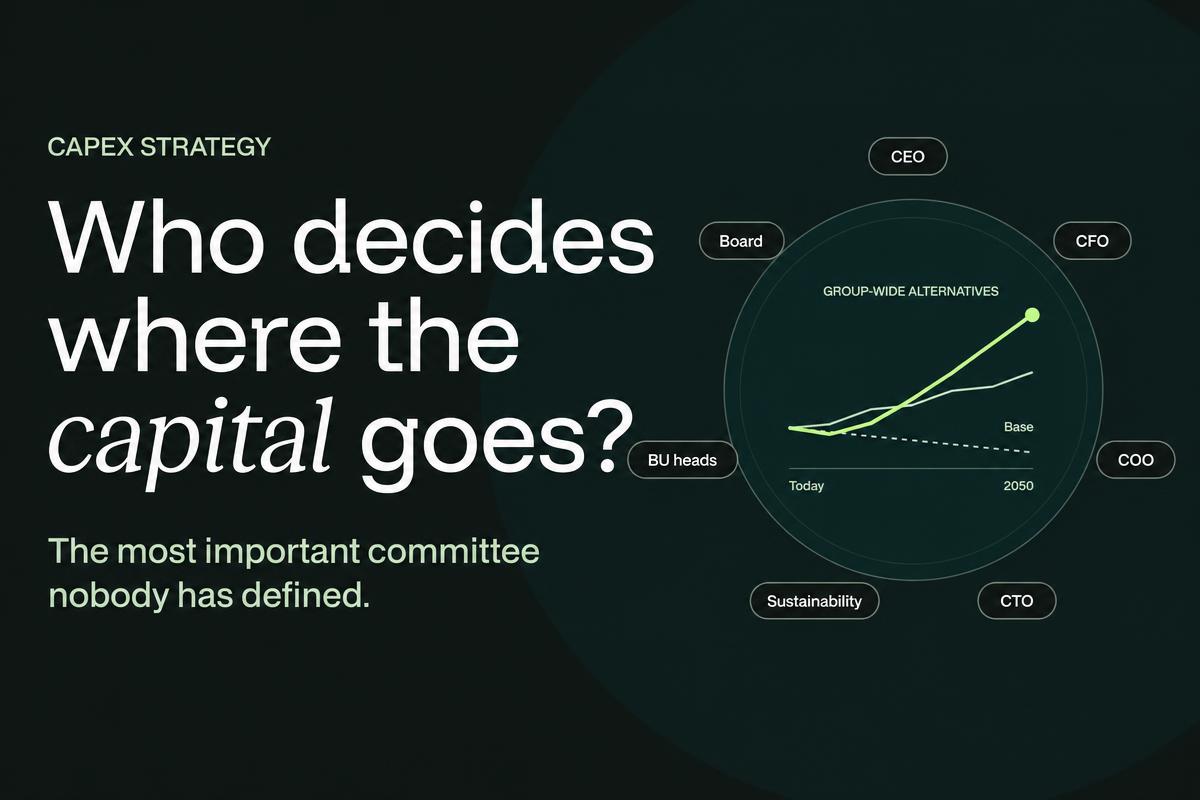
In almost every customer meeting I have had as CEO of Weissr, I ask the same question: who decides where the capital goes?
The answers vary more than you would expect. Some point to the CEO, who in many groups is the one who signs off the big strategic initiatives in the end. Some point to the board. Some point to the CFO. Some describe a monthly capex meeting where projects are approved one at a time. A few pause, look at each other, and say "well, it depends."
That pause tells me something important. In many capital-intensive groups, with a dozen or more sites and billions in capital employed, the most consequential decisions the business makes are taken by a forum that nobody has clearly defined.
The committee that exists on paper
Most pulp and paper, energy, metals and packaging groups run many sites across several countries and reinvest a large share of their cash flow in them every year. Few of them have an Investment Committee with a clear mandate to shape that spend at group level, over the next ten to thirty years.
What they usually have is a gate. Each site and business unit sends in its project requests. A group reviews each request against a hurdle rate, a payback threshold and the budget envelope. Good projects pass, weak ones are sent back, and the group's capex plan becomes the sum of what passed at every site. But is the sum of good projects a good plan?
This process is careful and well run, and it is the right way to manage projects once a direction is set. As a way to set the direction, it answers the wrong question. It asks "is this project good enough?" when the group needs to know "across all our sites, is this the best use of our capital, given where we want the company to be in fifteen years?" I wrote earlier about how the capex process quietly writes your strategy. The undefined Investment Committee is where that happens.
Who sits at the table
The lineup of this group-level forum varies enormously between companies, and the extremes are instructive.
At one end, the CEO is the Investment Committee. This is common in owner-led and family-controlled companies, and in businesses where one strong leader has shaped the asset base over many years. Decisions are fast and the direction is consistent. The risk is that every choice passes through one person's mental model of the company. Alternatives that the CEO has not already considered rarely reach the table, and the rest of the organization learns the outcome without understanding the reasoning.
At the other end sits a broad group of C-level executives. The CFO brings hurdle rates and the balance sheet. The COO brings reliability and maintenance needs. The CTO or head of technology brings new process options. The sustainability lead brings the CO2 pathway, and the business unit presidents bring the case for their own sites. Each of them holds a piece of the capex picture, and none of them has "capex" in their title. Everyone owns part of the decision, so nobody owns the whole of it.
Most companies sit somewhere in between, often with a CFO-led capex committee that reports to the board. In all three set-ups, I see the same pattern. The people around the table bring different priorities, different time horizons and different definitions of value. The lineup shapes the conversation, but the missing piece is the same: a shared mandate, a shared picture of the alternatives and a shared view of where the company should be in fifteen years.
What the committee is really for
If you strip away the meeting format and the approval forms, an Investment Committee in a capital-intensive company has three jobs:
- Decide where the company is going. Which sites to grow, which to run for cash, which to close, and which new capabilities to build.
- Compare real alternatives. Look at different ways to reach that position, side by side, on the same assumptions about markets, prices and the cost of carbon.
- Commit and follow through. Make a choice the organization understands, and turn it into a capex plan that sites can execute.
None of these jobs fit inside a single project request. They are about the portfolio, about how sites and investments interact, and about the value of choosing one path over another. A committee that only sees projects one by one cannot do them, no matter how skilled its members are.
A shared workspace for the decision
This is the gap Capex Strategy was built to fill. It gives the people who own group capital allocation one place to look at the long-term future of the whole asset base, whatever they call their forum.
It starts with a model of the group's cash flow, site by site, ten to thirty years out depending on the industry, and a Base Alternative: what happens if we keep operating our sites and reinvesting the way we do today. From there, the team builds Strategic Building Blocks, such as debottlenecking a mill, closing a line, converting a site to a new product or cutting emissions at a plant. Blocks combine into group-wide Strategic Alternatives, and each alternative is valued against the Base on the same assumptions about markets, prices and the cost of carbon.
The effect on the meeting is visible. The CEO, the CFO, the COO and the business unit heads are looking at the same long-term picture, built the same way. The conversation moves from approving this year's requests to choosing between futures for the group. Interactions between sites show up too. Closing one mill can make another more valuable, and a block that looks weak on its own can be worth a lot in combination, and vice versa. That only becomes visible at portfolio level.
Once the committee has chosen a direction, Capex Management carries it into the project pipeline at each site and makes sure the projects that get prioritized follow that direction. Together they form The Capex Platform. For the Investment Committee, the starting point is Capex Strategy: the long-term view of where the group's capital should go.
Clarity, confidence and efficiency
When I describe what a working Investment Committee gains, I come back to the three ideas at the core of The Capex Platform.
Strategic Clarity. Everyone in the room can see the alternatives, what each one assumes, and what the company looks like at the end of it. Strategy stops being a slide and becomes a set of choices with numbers attached.
Decision Confidence. The committee can test how robust a strategic alternative is before choosing it. What if the CO2 price doubles? What if demand in one market falls? A decision that has survived those questions is one the organization can stand behind, and one the board can defend.
Capital Efficiency. Capital flows to the sites and Strategic Building Blocks that create the most value for the portfolio, and away from projects that only made sense in isolation. Over a ten- to twenty-year horizon, the difference between the best alternative and the default path is often larger than any single investment on the list.
The order matters. Clarity comes first, because you cannot be confident in a choice you cannot see. Efficiency follows from the other two.
What I am taking from this
In my SaaS years at Admeta and Atomize, I sold optimization to people who already had a clear decision owner. A revenue manager owned pricing. A yield team owned the ad inventory. The software made a known decision better.
At Weissr, I have learned that the first step is often helping the customer see who owns the decision at all. When a company gives its Investment Committee a defined mandate and a shared workspace, the quality of the conversation changes within a few meetings. People argue about the future of the business instead of the format of the business case.
So here is my question for you. If your company spent its full capex budget next year, who would you hold accountable for whether it was the right portfolio? If the answer is "it depends", you may already have found your next strategic project.
Alexander Edström is CEO of Weissr, The Capex Platform for capital-intensive enterprises in pulp and paper, energy, metals and packaging. He has spent 20 years leading optimization SaaS companies, including Admeta (acquired by WideOrbit) and Atomize (acquired by Mews).