
CEO perspective
The Tail Wags the Dog: Your Capex Process Is Quietly Writing Your Strategy
Overview
Every project can clear the hurdle rate while the combined portfolio takes the company somewhere leadership never chose.
- Topic
- CEO perspective
- Written by
- Alexander Edström
- Published
- 16 September 2026
- Reading time
- 8 min read

From the CEO
Alexander Edström on capital decisions
Two months into my role as CEO of Weissr, I've learned that the fastest way to find out what a company really believes is to publish something and read the comments.
My first article argued that capital allocation is strategy. The response was bigger than I expected, and sharper. A global CFO pointed out that a ranked list of projects misses the dependencies between them. A finance partner argued the problem is behavioral, not analytical. Several people said some version of the same thing: every project we approve has a positive NPV, and we still end up somewhere we didn't choose.
That last sentence is the subject of this article. At Weissr we have a name for it, borrowed from a white paper my colleagues wrote almost a decade ago: the tail wags the dog.
Inside the process
What it looks like from the inside
Here is how strategy is supposed to work in a capital-intensive company. Leadership decides which businesses to be in and what role each site should play. That strategy determines which investments happen, in what order, and when. Capital follows strategy.
Here is how it actually works in most of the companies I've met this fall.
Projects come up from the sites. Each one is evaluated on its own merits, against its own base case, with a business case built by people who want it to happen. Each one clears the hurdle rate. Each one gets approved, or deferred to next year, or traded against another project in a meeting where, as one investment director put it, the loudest voice wins. Year after year, the sum of those individual decisions decides which sites grow, which ones stagnate, and which ones quietly become uncompetitive.
Nobody decided that. It happened. The capex process wrote the strategy, one sound project at a time.
That's the tail wagging the dog. And in my experience so far, the companies most confident that it doesn't happen to them are the ones where it's most likely to be happening.
Portfolio logic
Why sound projects add up to a weak portfolio
I spent 20 years in optimization SaaS before this, and the pattern is familiar from every industry I've worked in. Local optimization is not the same as system optimization. A hotel that prices every room perfectly in isolation still leaves money on the table if it ignores what those prices do to demand on the next night. An ad placement that maximizes yield on one impression can cannibalize the one beside it.
Capex is the same problem with longer time horizons and far less forgiveness. Three things make it worse.
Every project is measured against the wrong baseline. The typical business case compares ‘do the project’ against ‘do nothing to this asset.’ But ‘do nothing’ is never neutral. Assets lose competitiveness whether or not you invest. The real question is what happens to the whole asset base under each alternative, including the one where you stop investing in a site altogether. Almost no company models that honestly, because the answer is sometimes uncomfortable.
Projects that pass individually are not independent. Two mills that each justify a capacity upgrade against the same demand forecast are, together, betting on demand that may only exist once. A commissioning delay at one site changes the cash flow of another. Ranking by NPV per dollar treats them as separate when they aren't. Portfolio construction, not project valuation, is the discipline that's missing.
Maintenance capex sets the strategy nobody chose. The largest share of capital in most industrial companies goes to keeping existing assets running. Those decisions rarely reach the strategy discussion because each one is small and obviously necessary. But sustaining a site for another five years is a strategic decision about that site. Made project by project, it's a strategy that's never been articulated, and therefore never been challenged.
The white paper's estimate, based on what my colleagues saw across dozens of companies, is that a typical capital-intensive company loses at least 30 percent of the value of its annual capex to this dynamic. I've asked customers whether that number feels high. Not one has said yes.
What leaders said
What I've heard since the first article
Three things have stuck with me from the conversations that article started.
A prospect with several hundred projects a year told us their post-approval process is mature and well-tooled. The gap is entirely before approval: there is no method for deciding how capital should be allocated across the portfolio before individual projects enter the funnel. They also said, candidly, that fixing it will be hard to sell internally, because it changes how projects are evaluated, and people have built careers on the current way.
A customer described how a single plugged number made a scenario look good for weeks before anyone noticed. Not fraud. Just a shortcut that survived because nothing was comparing that scenario to anything else.
And a CFO reminded me, publicly, that management must own the constraints and the decisions to defer. I agree completely. The point of seeing the whole system is not to let a model decide. It's so that when leadership decides, they're choosing a strategy rather than discovering one after the fact.
Systems approach
Turning the dog around
I don't think the answer is a better hurdle rate or a stricter approval gate. Both make the tail wag harder, because they make each individual project more defensible without asking what the projects add up to.
The answer, as I understand it two months in, is to reverse the order of operations.
Start with the asset base as a system: every site, every major asset, and a common view of what happens to all of it if nothing changes. Then define the strategic alternatives for that system, not for individual projects. Which sites should grow, which should be sustained, which should be run for cash. Compare those alternatives against each other, over the full lifecycle, on cash flow. Only then decide which projects belong in the plan, in what order, and at what time.
That's the method Fredrik Weissenrieder and Daniel Lindén described in Redesigning Capex Strategy, and it's what Weissr is built to make repeatable rather than heroic. Done by hand, it takes a small team of specialists months, which is why most companies do it once and then let the capex process take over again. Done with a connected system and the heavy lifting automated, it can be something a leadership team revisits every quarter, when tariffs shift or a competitor closes a line.
The strategy becomes something you set, rather than something you find out you had.
One question
Would your decisions describe the strategy you chose?
If you took every capex decision your company made in the last five years and laid them side by side, would they describe the strategy your leadership team would have chosen?
If you're not sure, the tail may already be wagging.
I'd like to hear how you keep strategy in charge of capital, rather than the other way around.
Key takeaways
- A portfolio of individually sound projects can still produce a strategy nobody chose.
- Local project optimization is not the same as optimizing the asset system.
- Hurdle rates cannot account for dependencies, shared demand assumptions or strategic sequencing.
- Maintenance decisions quietly determine which sites remain competitive.
- Leadership should define asset-level alternatives before projects enter the approval funnel.
Software solution
Capex Strategy
Compare strategic alternatives across the full asset base.
Software solution
Capex Management
Keep approvals, forecasts and execution connected to the decision.
Add-on module
Capex Budgeting
Turn strategic priorities into a funded capital portfolio.
Challenge
Capital Allocation
See how a systems approach changes portfolio construction.
By role
CEO & Executive Leadership
Connect capital choices to enterprise strategy.
Platform
AI in Weissr
Use AI to challenge alternatives while people retain the decision.
Alexander Edström is CEO of Weissr and has spent 20 years leading optimization-focused SaaS companies.
First published by Alexander on LinkedIn. Read the original article.
Explore more perspectives from the people behind the platform in Capex Experts.
Follow Weissr on LinkedInfor new Capex Blog posts.
Keep reading
All Capex Blog posts
Capex maturity
How Mature Is Your Capex Process? Find Out in 3 Minutes
Signs your Capex process has not kept pace with the business, and a three-minute assessment to see where you stand.
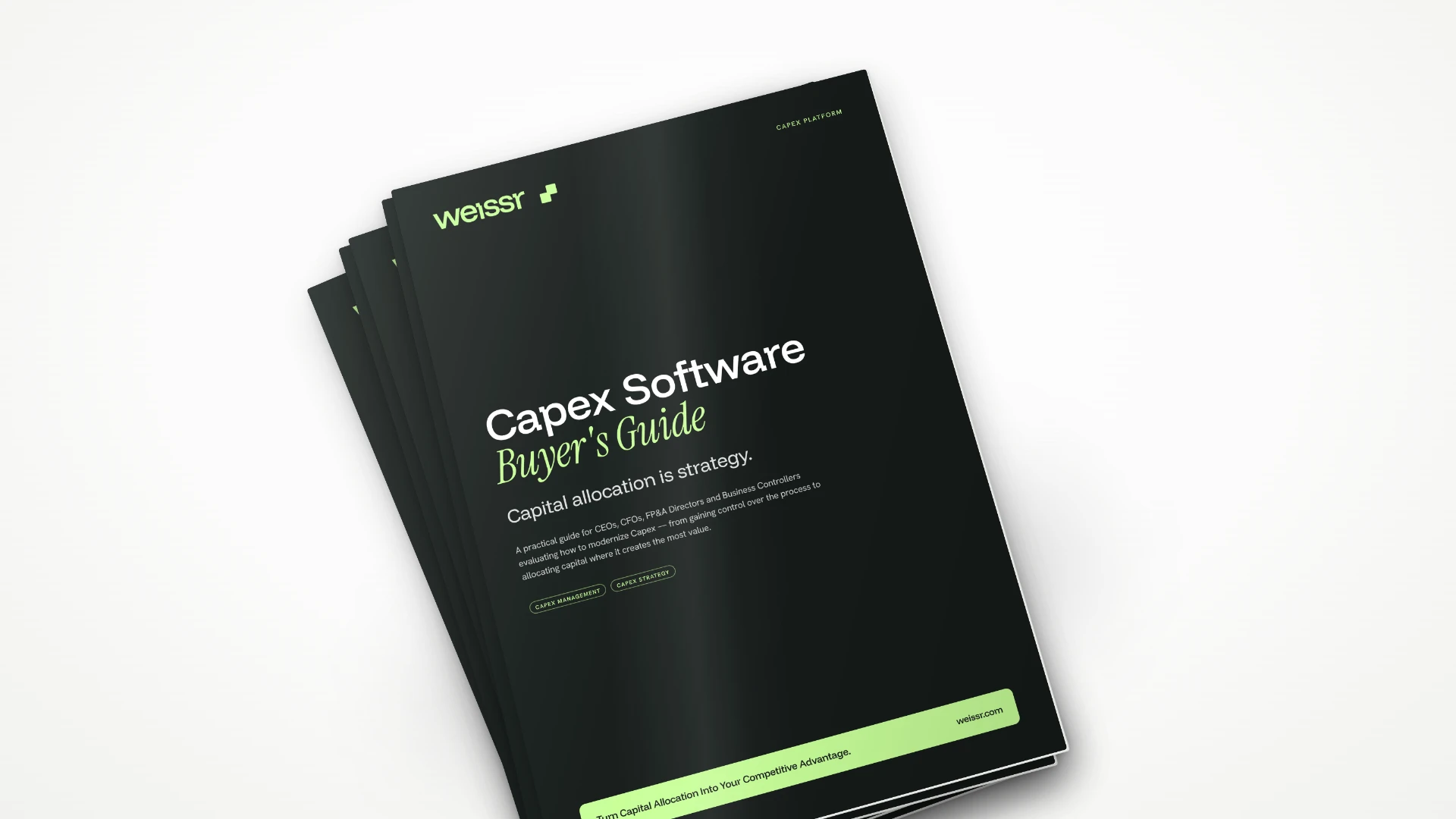
Buyer's guide
Best capital planning software: a buyer's guide for finance leaders
How to tell capex, capital planning and project software apart, and ten criteria to check before you compare vendors.

CEO perspective
Capital Allocation is Your Strategy
Why the companies that outperform on capex will not be those that invest most, but those that allocate best and reallocate fastest.

Capex fundamentals
Capex vs Opex: the line that decides who gets to say yes
Capital expenditure and operating expenditure explained in plain language, with examples, a comparison table and the practical effect on financial governance.

Capex fundamentals
Capex, explained: what capital expenditure really means in practice
A plain-language introduction to capital expenditure: the categories, the vocabulary, and how capex actually moves through an industrial organisation.

Capex process
Inside the capex process: six decisions between a strategy and a built asset
How strategy, planning, budgeting, approval, execution and review connect, and why weak handovers undermine capital decisions.

Capex governance
Why capex approvals take months and what actually shortens them
A practical look at the capex approval process, where delays arise and how each stage should work.

Capex forecasting
Why capex forecasts are inaccurate, and why the miss goes unmeasured
Why replacing each quarterly forecast makes accuracy difficult to measure, and what companies lose when the history disappears.

Our story
The Weissr story: from capex advisory work to a Capex Platform
Where Weissr comes from: the founders, the methodology behind the book and how it became a platform for the whole Capex cycle.
Capex Maturity Assessment
What's yourCapex maturity level?
Answer a short set of questions on process, data, visibility and cash flow, and get a report showing your level in each area.
Take the assessmentCapital decisions
Questions for leadership teams,answered directly.
What does ‘the tail wags the dog’ mean in capex?
It describes a company where bottom-up project approvals collectively determine strategic outcomes, instead of an explicit enterprise strategy determining which investments should happen, where and when.
Why can profitable capex projects create a weak portfolio?
Projects are interdependent, often rely on the same demand assumptions and compete for one limited capital pool. Evaluating each against its own baseline misses the value and risk of the combined portfolio.
Why is a hurdle rate not enough for capital allocation?
A hurdle rate can show that an individual project is acceptable, but not whether it is the best use of capital compared with every competing alternative across the asset base.
How can leadership keep strategy in charge of capex?
Start with the asset base as one system, define strategic alternatives for sites and assets, compare those alternatives over their full lifecycle, and only then select and sequence the projects that implement the chosen direction.
Put strategy back in chargeof capital.
See how Weissr connects capital allocation, budgeting and execution across the enterprise.
Book a demo