
Fragmented investment demand
Requests arrive through spreadsheets, presentations and email.
Solutions by role · FP&A & Capital Planning
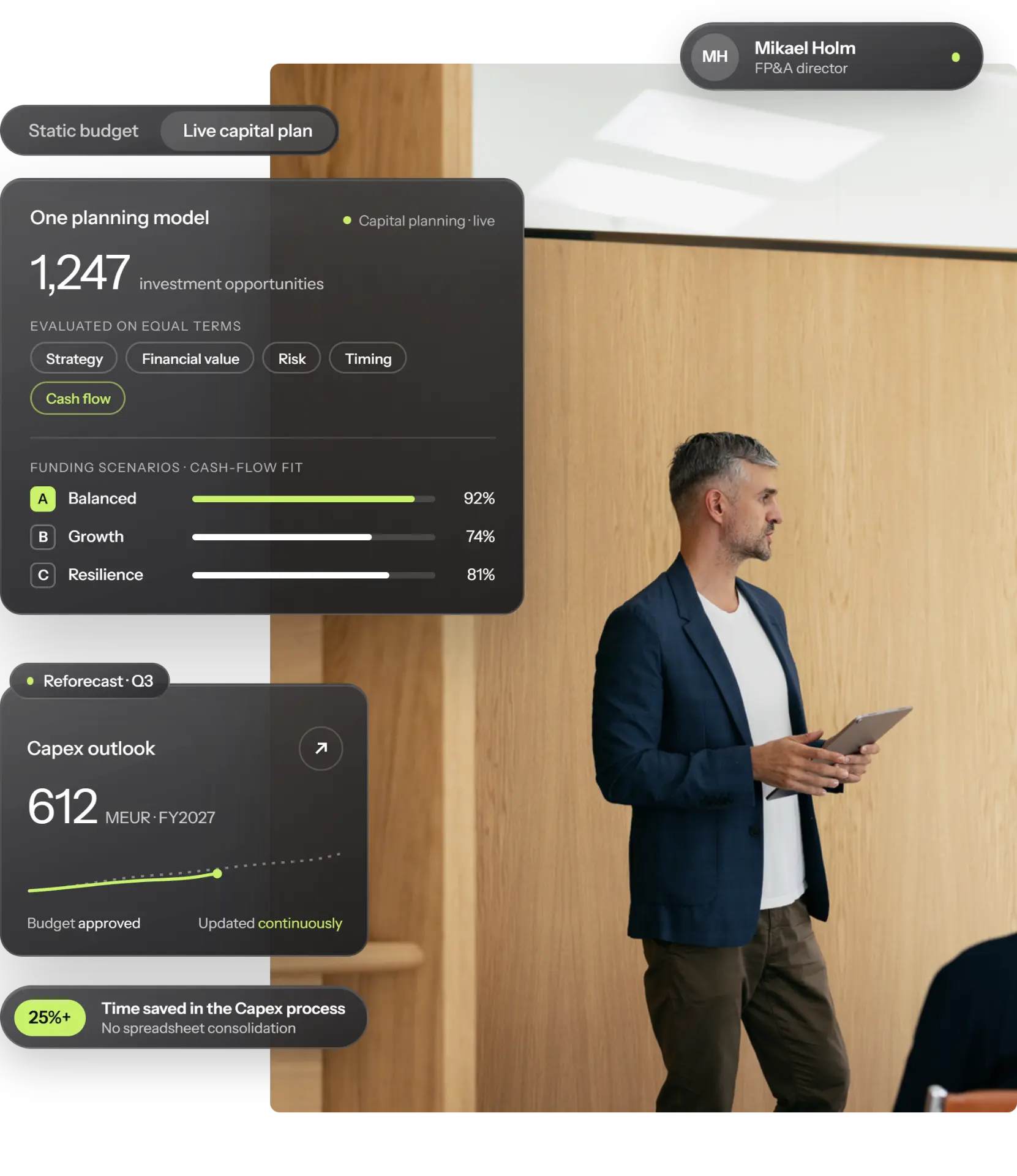
Bring every investment opportunity into one planning environment so FP&A can compare, prioritise, budget and reforecast Capex across the organisation.
The planning challenge
FP&A should not have to spend the planning cycle chasing spreadsheets, normalising business cases and reconciling different versions of the truth. The team can then focus on helping the organisation decide where available capital should go.
Requests arrive through spreadsheets, presentations and email.
Different business cases make investments difficult to compare.
An annual Capex budget can’t keep pace with changing business conditions.
One planning model
Move from raw demand to an approved, continuously updated capital plan in one connected process and tool.
Collect investment demand across business units.
Apply consistent assumptions, financial logic and evaluation criteria.
Evaluate competing investments on equal terms.
Build alternative investment and funding scenarios.
Turn priorities into an approved capital plan.
Follow spend against the plan and update the forecast as conditions change.
Verified customer outcome
25%+
Time savings in the Capex process
10%+
Better cash flow from decisions
9 weeks
From implementation start to operational system
“One of the most valuable benefits of Weissr is the time saved. With all the information centralized and easily accessible, our processes have become much more efficient, especially for follow-ups and approvals.”
Finance Lead at a European Corporation
Verified customer perspective
Customer stories from people in your role
Nordic Saw Milling Company
Explore customer storiesWeissr · Portfolio intelligence
Workspace
Portfolio value
Strategic fit
Capital plan
On track
Risk exposure
Controlled
Portfolio outlook
Investment demand
The Weissr platform
Capture opportunities consistently across the organisation.
Turn priorities into an approved, governed budget.
Compare alternative allocation and funding choices.
See the timing and impact of planned investment.
Update the outlook as assumptions and delivery change.
Present one forward-looking view to leadership.
Before and after
Guides and reports
Guide
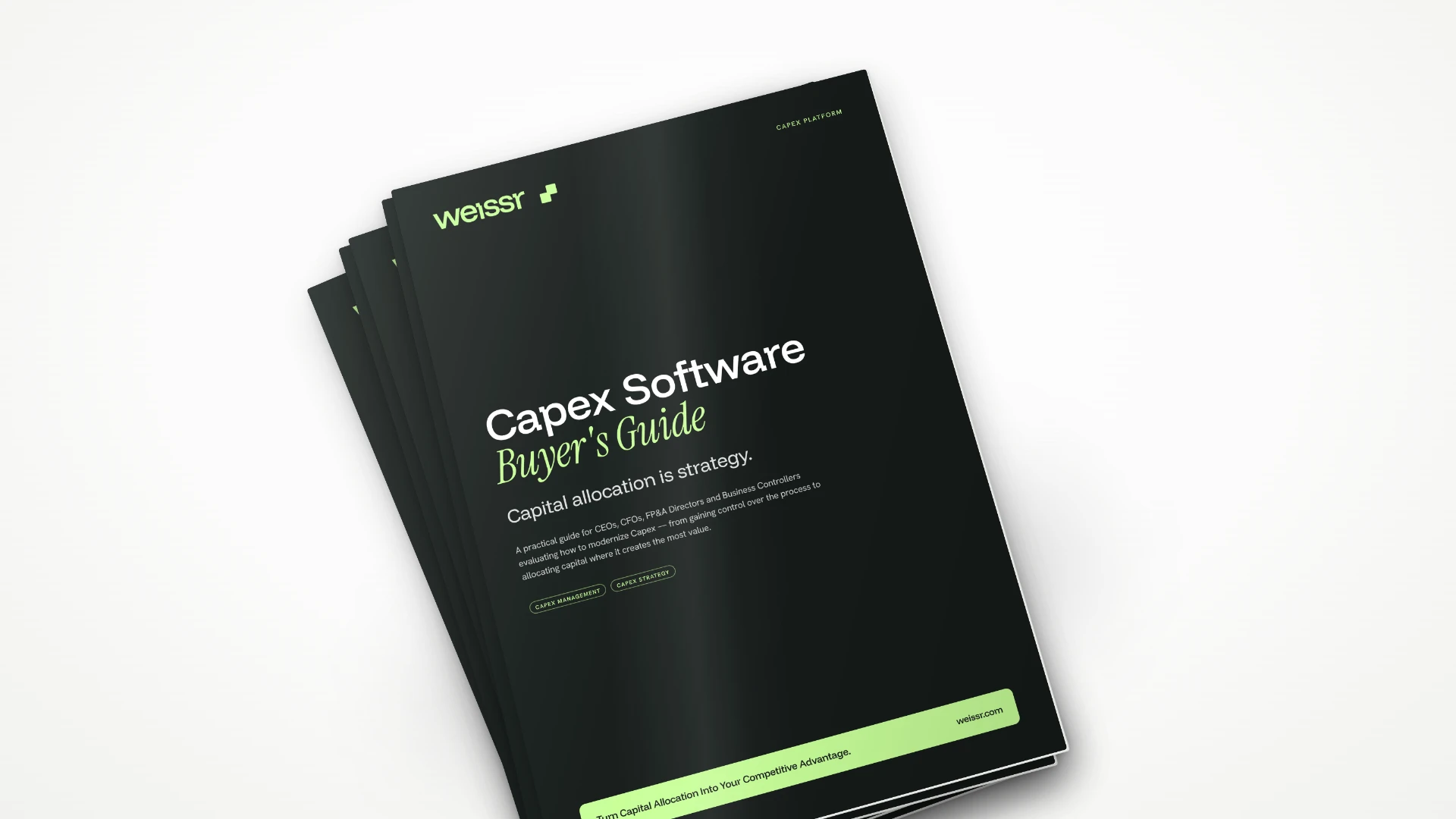
What to look for when you replace spreadsheets with a capex platform, and the questions to ask vendors.
Download the guide →
Report
Benchmark your planning process against five maturity levels and see what the next step involves.
Download the report →Explore
Build, challenge and approve the capital budget in one system.
Explore
Set the long-term Capex direction that maximises company-wide cash flow.
Explore
Register and track approved budgets against actuals and forecast.
Capability
Prioritise competing requests before the budget is set.
Challenge
Compare complete portfolios instead of single business cases.
Capex Maturity Assessment
Answer a short set of questions on process, data, visibility and cash flow, and get a report showing your level in each area.
Take the assessmentCapex explained
Capex planning software helps finance teams collect investment demand, evaluate proposed investments, build capital budgets, model alternative scenarios and forecast capital expenditure across the organisation.
Weissr connects capital planning with both Capex Strategy and Capex Management, allowing FP&A to see how investment decisions move from strategic priority to budget and execution.
Capital planning is the process of identifying, evaluating, prioritising and funding investments within strategic and financial constraints.
Capex budgeting converts prioritised investment demand into an approved plan with funding, timing and accountability.
Capex forecasting updates expected investment cash flows using current project timing, commitments, actuals and revised assumptions.
General FP&A tools plan company-wide financial performance; Capex planning software adds investment-level evaluation, portfolio scenarios and lifecycle governance.
Capture demand across the organisation, standardise assumptions, compare investments, model constraints, approve a portfolio and continuously reforecast it.