Weissr

Weissr Capex Platform · Weissr Capex Strategy

Capex strategy software for whole-business capital allocation

Turn capital allocation into competitive advantage.

Define the right Capex strategy, one that puts capital where it creates the most long-term cash flow before budgets are drawn up. Simulate different scenarios, compare alternative strategies for the whole business and determine where capital should be allocated to create the greatest financial impact.

ISO 27001 certifiedSAP & Oracle integration1,000+ production sites globally

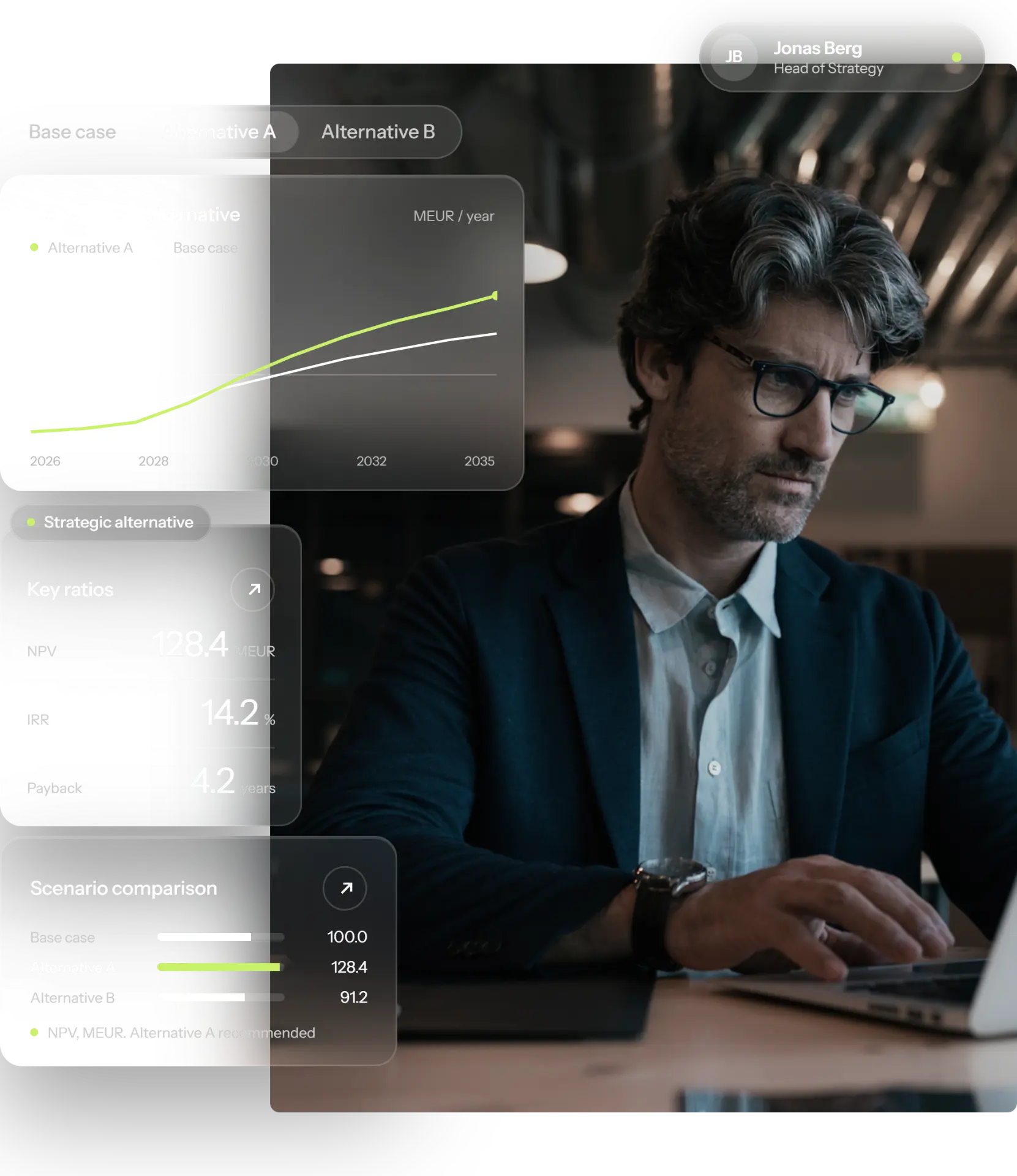
Head of Strategy comparing base case and alternative scenarios with NPV, IRR and payback in Capex Strategy

Trusted by

Stora Enso logoBoliden logoEnpro logoSonoco logoAxel Christiernsson logo

Rethinking capital allocation

Move beyond project approvalto company-wide capital allocation.

Project approval asks whether an investment should proceed. Capex Strategy starts one level up: it designs the configuration of sites, lines and capacity the business should run, and the investments follow from that design.

Traditional approach

  • Project-by-project evaluation in isolation
  • Bottom-up: strategy emerges from individual decisions
  • “Delta” thinking: one project at a time, against its own baseline
  • Closures treated as constraints, horizons too short

The Weissr Way

  • System-level optimisation across the full asset base
  • Top-down: a defined strategy governs every capex decision
  • Whole-business cash-flow modelling against alternatives
  • Closures as active decisions, long horizon, scenario-tested

Built for

Different roles.One strategic framework.

CEO · Group CEO · President

See where capital contributes most to company strategy and long-term cash flow.

Weissr for CEOs
  • A system-level view of how capital creates value across the full asset base
  • Structured comparison of whole-business alternatives, not individual projects
  • Clear directives that govern every downstream budget decision
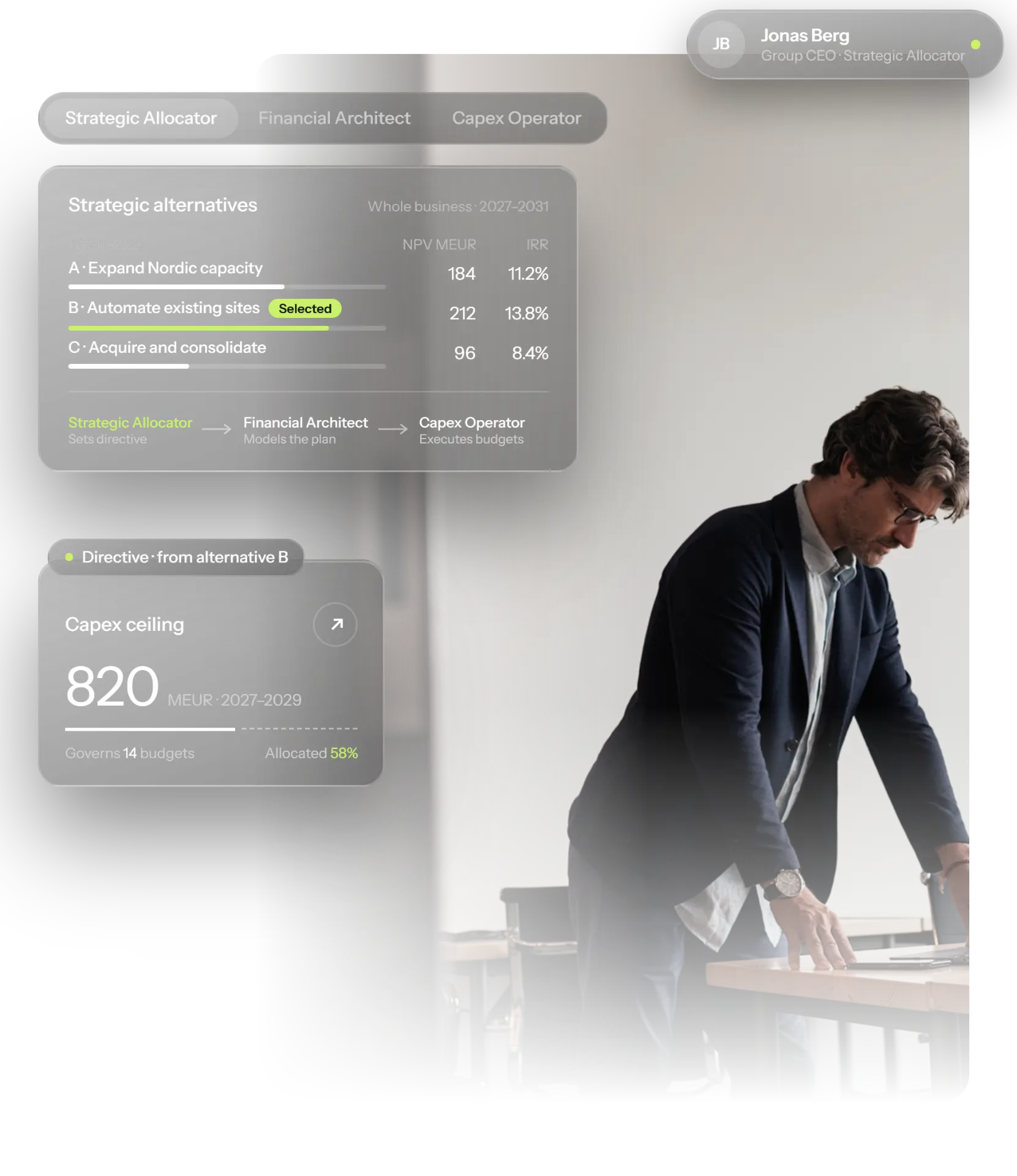
Strategic Allocator view comparing strategic alternatives and the governing capex ceiling directive

How Capex Strategy works

One model of your industrial system.Unlimited strategic alternatives.

Model your full production network, existing and future assets, and evaluate alternatives built from Strategic Building Blocks.

Typical Strategic Building Blocks

Capacity expansion

Add capacity where demand and economics support it.

Technology upgrade

Modernise lines and machines for cost or product mix.

Asset replacement

Replace end-of-life assets in line with strategy.

Closure & consolidation

Close or consolidate sites as an active strategic move.

Relocation

Move production to better-positioned assets or geographies.

New lines & sites

Add new production lines or sites where the market and the economics justify it.

Product mix change

Shift volume towards products that earn more cash.

The six-step Capex Strategy process: open a step to read more

From strategy to action

Strategy decisions become governing directivesand guide the next budget cycle.

The approved group strategy sets the directives and envelopes that frame every budget cycle and flow directly into Weissr Capital Budgeting. Every directive is derived from the approved system design, not negotiated site by site.

  • Site strategy: Develop, Maintain or Close (with target year)
  • Max payback years: acceptable investment horizon by site
  • Asset-category priorities: where capital is steered, where held back

Site strategy parameters: example

Directives
SiteStrategyMax payback
Site A, AntwerpDevelop8 years
Site B, LinzMaintain4 years
Site C, StenungsundClose (2031)2 years
Site D, HoustonDevelop10 years

+100%

Potential uplift in future cash flow

25+ yrs

Capital allocation expertise, productised

1,000+

Production sites modelled in the system

Customer story · Capex Strategy

A four-site network,one strategic answer.

“We had four sites, twelve years of capex plans and no way to compare them as one system. In three weeks we modelled the whole network and tested nine alternatives. The strategy we approved was not on anyone’s original project list — and it was worth €180M more in cash flow.”
Portrait of Erik Lindqvist

Erik Lindqvist

Group Head of Strategy, Nordic packaging & materials group

Value identified

+€180M

additional NPV vs. the bottom-up plan · 9 alternatives compared · 3 weeks to decision

Capabilities

Built for whole-business decisions,not project paperwork.

Just-a-click comparison

Compare whole-business alternatives instantly, same model, same assumptions.

Company-wide cash-flow model

Every site, line and machine, current and future, in one coherent model.

Unlimited iterations

Iterate without rebuilding spreadsheets or breaking the audit trail.

Scenario & sensitivity testing

Stress-test against demand, price, cost and policy scenarios.

Automated workflows & reports

Approval workflows and board-ready presentations, generated for you.

Transparent change log

Every assumption and revision tracked, auditable and defensible.

Part of a closed loop

Capex strategy that makes each budget cycle and project smarter.

Three tightly integrated modules sharing one asset base, with every capital expenditure linked to exactly one asset, so execution data updates the asset record and feeds back into strategy.

One asset base · three connected modules

01

Capex Strategy

Defines where capital should go based on long-term priorities. Models the asset base, evaluates strategic alternatives and produces the directives that frame every budget cycle.

02

Capital Budgeting
Reconciles strategy with demand. Governs allocation, scenarios and approvals through Capital Allocation Pools at Group, Division, Business Area and BU level.

03

Capex Management
Executes projects and feeds results back for smarter next cycles. Approved budgets and phasing flow straight from Capital Budgeting, with no re-entry and no manual handover.
Feedback loopStrategy inApproved budgetsActuals, asset updates & bottom-up demand

Direct integration with financial data from ERP and asset data from EAM systems.

See all integrations
We have actively deployed the Weissr approach to capital allocation and have executed investments that are creating real competitive advantage.
Portrait of Stephen Scherger, EVP & CFO at Graphic Packaging International

Stephen Scherger

EVP & CFO, Graphic Packaging International

The simplicity in the methodology has helped us focus on company cash flow and long-term strategy.
Portrait of Henrik Sjölund, President & CEO at Holmen

Henrik Sjölund

President & CEO, Holmen

Capex Strategy FAQ

Frequently askedquestions.

Capex strategy is the decision, made years ahead of individual projects and budgets, about where the company will allocate capital to fixed assets: which sites, production lines and asset categories to build, upgrade or retire. Weissr Capex Strategy lets capital-intensive companies design, compare and decide on whole-business strategic alternatives, which are complete plans for how every site, line and machine should evolve over 20 years or more. Many alternatives can be built by combining decisions such as expanding capacity, upgrading technology or closing a site. They are compared on company cash flow until the best one emerges, and the approved strategy becomes the directives that guide every downstream capex decision.

Read more about capital allocation and Capital allocation is your strategy.

Capex strategy decides where capital should go over the long term, on the whole asset base. Capex planning then decides which investment requests to fund and in what order in the coming period, within that direction.

Read more about Capex planning and portfolio prioritisation.

Capex strategy designs the long-term system configuration: which sites, lines and capacity the business should run. Capital planning sequences that direction across several years, and capital budgeting turns one period of it into an approved, funded envelope with allocation pools and authority limits. The three are stages of one process rather than separate activities.

Learn more about capex planning software and capital budgeting software.

Weissr keeps one rolling capital plan across sites, business units, entities and currencies. Teams can compare alternatives without rebuilding the model or allowing local versions to diverge. Investments are classified by driver, such as maintain, comply or grow, so leadership can balance protection of existing capacity with investment in new capability.

The approved group strategy is translated into explicit capex directives and investment envelopes. Every request in Capital Budgeting and Capex Management is then evaluated against those directives, so alignment is enforced by the rules the strategy produced rather than negotiated site by site.

Read more about Capex Management and the capital allocation framework.

A strategic alternative is a complete, company-wide cash-flow model of one possible direction: a specific configuration of sites, lines and capacity with its investment needs and financial outcome over the horizon. Alternatives are compared on equal terms, so leadership chooses between fully costed futures instead of picking from a project list.

Scenarios stress-test the chosen direction against changes in demand, prices, costs, regulation and asset condition. Because every alternative is modelled on the same asset base, leadership can see how robust the strategy is before directives and envelopes are set for the coming budget cycles.

The approved group strategy produces the directives and envelopes that frame every budget cycle. Every budget cycle is compared against the strategy, and any gap between the strategic need and the approved envelope is visible and explained.

See Weissr Capex Strategyin action.

Book a demo and see how strategic capital allocation applies to your organisation.

30-minute demo. No commitment.