
CEO perspective
Capital Allocation is Your Strategy
Overview
The companies that consistently outperform on capex will not be the ones that invest the most. They will be the ones that allocate best and reallocate fastest.
- Topic
- CEO perspective
- Written by
- Alexander Edström
- Published
- 7 September 2026
- Reading time
- 9 min read

From the CEO
Alexander Edström on capital decisions
I've spent my first weeks as CEO of Weissr doing mostly one thing: listening. To our customers in pulp and paper, energy, metals, and packaging. To the team that has built this company over 25 years. And to the book that started it all.
I come to this from 20 years of building SaaS companies around one idea: that machines are very good at finding the optimal answer inside a frame that humans set. At Admeta we did it for advertising yield, until WideOrbit acquired the company in 2014. At Atomize we did it for hotel pricing, until Mews acquired it in 2024. In both cases the pattern was the same. The industry ran on spreadsheets and gut feel. The plan was set once and defended for a year. And the moment you gave decision-makers a live, connected view and a recommendation they could interrogate, the whole rhythm of the business changed.
Capex is the largest optimization problem I've encountered. It's also the one with the least room for error. And for many capital-intensive enterprises, it still is: run without a dedicated system, project by project, in Excel, rebuilt from scratch each time, disconnected from the assets it's meant to serve.
When Fredrik Weissenrieder and Daniel Lindén published Redesigning Capex Strategy in 2022, they made an argument that sounded provocative and turned out to be simply true: most companies treat their assets as standalone performers. They approve projects one at a time, each with a business case that says yes. And they never ask the only question that really matters: What role does this asset play in the network, and where does the next dollar of capital create the most cash flow for the whole?
John Williams, then CEO of Domtar, put it in one line in the foreword: capex strategy is the enterprise's strategy.
I didn't fully appreciate how literal that is until I sat down with the people who actually make these decisions.
Customer lessons
Three things I learned from customers this summer
1. Every project looks profitable. That's the problem.
A group investment leader at one of our longtime customers described the pattern plainly. Inside a large project team, hundreds of small assumptions each drift a little optimistic, because everyone wants the project to happen. No single assumption is wrong. The sum is. And when every request comes with a strong business case, the challenge isn't finding good investments. It's knowing which ones deserve capital most when the CFO caps the total.
That's a portfolio question. Spreadsheets and approval workflows were never built to answer it.
2. The risk is usually in the risk assessment.
Another customer walked me through a major new production line that came online almost exactly as new tariffs hit its main export market. The Monte Carlo simulation had a P10 outcome. Nobody had asked whether that outcome was a scenario they actually believed would happen, or what they would do if it did.
Distributions aren't scenarios. Averages aren't marginal economics. If the tool doesn't help decision-makers live through a plausible bad case before they commit 25 years of capital, it hasn't done its job.
3. The bottleneck is data, not technology.
When we asked customers where their trust boundary sits with AI-supported decisions, the answer was unanimous and immediate: the data. Pulling operational data for a single site can take days. Base cases are one to two months old by the time they're used. Interoperability between systems is worse than any vendor assumes.
I take that as a design brief, not an excuse.
The new context
Why this matters more in 2026 than it did in 2022
Capital is flowing again, and not just into AI. Energy transition, reshoring, grid and transportation infrastructure, critical minerals. McKinsey puts the cumulative infrastructure need at roughly $106 trillion through 2040. Manufacturers who deferred for years are finding that the cost of waiting now exceeds the cost of acting.
At the same time, the ground keeps moving. Tariffs redraw trade flows within a quarter. Energy and raw material costs swing on geopolitics. Cycles that used to run seven years no longer do.
More capital, under more uncertainty, with less room for error. The era of the static capital plan, set once a year and defended for twelve months, is over. I watched the same shift happen in advertising and in hospitality: the winners weren't the ones with the biggest budgets but the ones who could see the whole system and reallocate continuously. The companies that consistently outperform on capex won't be the ones that invest the most. They'll be the ones that allocate best and reallocate fastest.
Platform direction
Where Weissr goes from here
Our vision hasn't changed: to be the Capex Strategy Execution Platform for the entire capex cycle, from strategy to budgeting to management, and the decision hub in the enterprise's increasingly automated ecosystem.
Here's how I read that vision after this summer.
Capex strategy is the framework everything else optimizes within. ERP, asset management, supply chain optimization: these systems will increasingly run themselves. But automation can optimize inside a frame; it can't set the frame. Someone still has to decide which businesses to be in and which assets to own ten years from now. In a capital-intensive company, that decision is the capex strategy. That's the job we anchor.
AI does the heavy lifting. Humans keep the decision. Our customers were clear: recommend, never decide. I agree, and not as a concession. In hotel pricing, an algorithm can reprice a room a hundred times a night and be wrong occasionally at little cost. A capex decision is the opposite. Capex decisions can't be undone, there's no single right answer, the bet changes the world around it, and someone has to answer to the board. What AI should do is what our customers asked for: build base cases in hours instead of weeks, generate and challenge alternatives, rank them per dollar of capital under a real constraint, run the cross-site comparisons that today never happen, and act as the neutral voice that questions the optimistic drift inside a project team.
Connect, don't replace. Our customers don't want another system of record to migrate to. They want a constantly connected picture of assets, actuals, prices, and project status, not a one-time load that's stale three months later. So we're building Weissr to plug into the systems they already run.
Replace the spreadsheet, not the workaround. For most of these companies, the base case for a capital plan still lives in Excel, rebuilt by hand, disconnected from the actuals and assets it's supposed to represent. That's not a missing feature. It's the absence of a system, and it's the starting point we design against.
Reach the market, not just the mill. The most consistent request I heard was for external intelligence: supply and demand, competitor moves, trade flows, footprint. Decision-makers don't trust a model on its own. They want a strategic narrative: What's the trend? What's the market? Why does this improve our position? A decision hub that stops at the fence line of the plant hasn't earned the name.
A commitment
Make the method usable every quarter
Weissr started as a method, a systems-thinking approach to the asset base that our founders proved across six continents before it became software. My job is to make that method usable every quarter rather than every other year, by many people rather than a few specialists, and with the honesty about data quality that our customers deserve.
Capital allocation is strategy. My intention is that no CFO or CEO of a capital-intensive company should have to build that strategy in a spreadsheet.
I'd like to hear how you make these decisions today, what you'd trust AI to help with, and what you never would.
Key takeaways
- Capital allocation determines the future shape of a capital-intensive enterprise.
- A collection of profitable projects is not necessarily the strongest portfolio.
- AI should challenge and accelerate the analysis while leadership retains the decision.
- Connected data is the prerequisite for a capital plan that can adapt continuously.
- The winners will allocate better and reallocate faster, not simply spend more.
Software solution
Capex Strategy
Compare strategic alternatives across the full asset base.
Software solution
Capex Management
Keep approvals, forecasts and execution connected to the decision.
Add-on module
Capex Budgeting
Turn strategic priorities into a funded capital portfolio.
Challenge
Capital Allocation
See how a systems approach changes portfolio construction.
By role
CEO & Executive Leadership
Connect capital choices to enterprise strategy.
Platform
AI in Weissr
Use AI to challenge alternatives while people retain the decision.
Alexander Edström is CEO of Weissr and has spent 20 years leading optimization-focused SaaS companies.
First published by Alexander on LinkedIn. Read the original article.
Explore more perspectives from the people behind the platform in Capex Experts.
Follow Weissr on LinkedInfor new Capex Blog posts.
Keep reading
All Capex Blog posts
Capex maturity
How Mature Is Your Capex Process? Find Out in 3 Minutes
Signs your Capex process has not kept pace with the business, and a three-minute assessment to see where you stand.
Buyer's guide
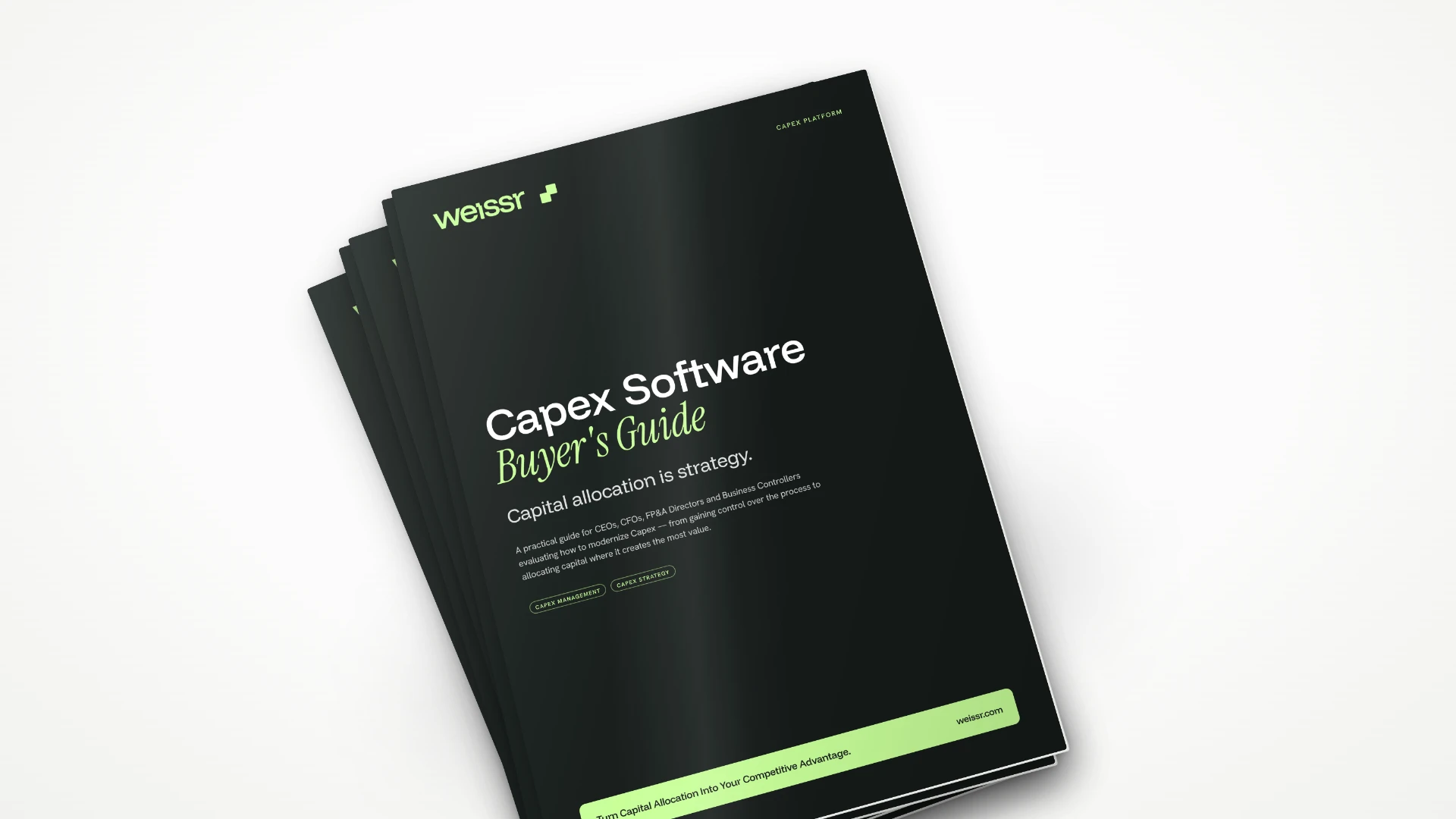
Best capital planning software: a buyer's guide for finance leaders
How to tell capex, capital planning and project software apart, and ten criteria to check before you compare vendors.

CEO perspective
The Tail Wags the Dog: Your Capex Process Is Quietly Writing Your Strategy
Every approved project can have a positive NPV while the portfolio still takes the company somewhere leadership never chose.

Capex fundamentals
Capex vs Opex: the line that decides who gets to say yes
Capital expenditure and operating expenditure explained in plain language, with examples, a comparison table and the practical effect on financial governance.

Capex fundamentals
Capex, explained: what capital expenditure really means in practice
A plain-language introduction to capital expenditure: the categories, the vocabulary, and how capex actually moves through an industrial organisation.

Capex process
Inside the capex process: six decisions between a strategy and a built asset
How strategy, planning, budgeting, approval, execution and review connect, and why weak handovers undermine capital decisions.

Capex governance
Why capex approvals take months and what actually shortens them
A practical look at the capex approval process, where delays arise and how each stage should work.

Capex forecasting
Why capex forecasts are inaccurate, and why the miss goes unmeasured
Why replacing each quarterly forecast makes accuracy difficult to measure, and what companies lose when the history disappears.

Our story
The Weissr story: from capex advisory work to a Capex Platform
Where Weissr comes from: the founders, the methodology behind the book and how it became a platform for the whole Capex cycle.
Capex Maturity Assessment
What's yourCapex maturity level?
Answer a short set of questions on process, data, visibility and cash flow, and get a report showing your level in each area.
Take the assessmentCapital decisions
Questions for leadership teams,answered directly.
Why is capital allocation a strategy decision?
In a capital-intensive company, capital allocation determines which businesses, sites and assets will grow, be sustained or be exited. Those choices shape the future enterprise, so the allocation of capital is the practical expression of strategy.
Why is project-by-project capex approval not enough?
Each project can have a positive business case while the combined portfolio remains weaker than another possible use of the same capital. Leadership needs to compare complete alternatives under one capital constraint.
How can AI support capital allocation?
AI can accelerate base-case creation, generate and challenge alternatives, compare investments across sites and expose optimistic assumptions. Leadership should retain accountability for the final decision.
Why do spreadsheets limit capex strategy?
Spreadsheets separate plans from live asset, market and actual-cost data. They make portfolio comparisons slow to rebuild and encourage static annual plans rather than continuous reallocation.
Put strategy back in chargeof capital.
See how Weissr connects capital allocation, budgeting and execution across the enterprise.
Book a demo