
01
Capital strategy
Where should capital go over the long term?
Sets the investment direction, the total envelope and the balance between maintaining existing capacity, meeting regulatory obligations and building new capability.
Capex process
Overview
A sound capex process keeps the reasoning behind an investment intact from strategy through delivery and review.

The short answer
The capex process is the end-to-end cycle through which an organisation decides, authorises, delivers and reviews capital investments. It has six connected phases: capital strategy, capex planning, capital budgeting, approval, execution and post-investment review.
Treated as six separate exercises, the process leaks. Assumptions made during planning are gone by the time a request is approved; the case that justified an investment is unavailable when its cost is questioned; and nobody checks afterwards whether the promised benefit arrived. A connected cycle carries the reasoning from one phase into the next and gives capital governance a consistent basis.
The six phases
01
Where should capital go over the long term?
Sets the investment direction, the total envelope and the balance between maintaining existing capacity, meeting regulatory obligations and building new capability.
02
Which investments make the plan, and in what order?
Candidate investments from every site are classified, scored on consistent criteria and ranked against strategic contribution, risk of deferral and delivery capacity.
03
What is actually funded this period?
The agreed plan becomes an approved budget with allocation pools, timing, contingency and authority limits. Every subsequent request draws on this envelope.
04
Is this specific investment authorised?
Each request is validated against available budget and routed through the delegation-of-authority matrix, producing an auditable record of who decided what and when.
05
Are we delivering what was approved?
Projects run against the approved baseline with live cost, commitment and forecast-at-completion tracking, and scope changes re-enter approval at the correct authority level.
06
Did the investment deliver its case?
Delivered cost, schedule and realised benefit are compared with the approved case, producing evidence that improves the next round of estimating and prioritisation.
Capex vs opex
Capital expenditure creates or extends an asset: it is capitalised on the balance sheet and depreciated over the asset's useful life. Operating expenditure is consumed in the period and expensed immediately. The distinction also determines approval authority, reporting treatment and, in most jurisdictions, tax position. We unpack it in Capex vs Opex.
In practice the boundary cases matter most: major overhauls, software implementations, spare-parts strategies and turnaround work often sit close to the line. A capex process that classifies these consistently avoids both understated capital plans and disputes at audit.
Where it breaks
Each phase is usually owned by a different function and lives in a different tool. Strategy is a slide deck. Planning is a set of spreadsheets that diverge within days of being circulated. Budgeting happens in the finance system. Approval happens in email and a signing tool. Execution happens in a project tool that knows nothing about the investment case. Review usually does not happen at all.
Each handover makes it easier to lose assumptions, decisions and changes. An organisation can therefore have strong controls within each function but still deliver a portfolio that no longer reflects the original priorities.
Improving the process
Key takeaways
Product
Turn competing requests into one prioritised plan.
Blog
The approval phase in detail, stage by stage.
Product
Govern execution against the approved case.
Product
Where the process starts: long-term investment direction.
Product
Convert the agreed plan into a funded, governed budget.
By role
How planning teams run the cycle end to end.
Follow Weissr on LinkedInfor new Capex Blog posts.

Capex maturity
Signs your Capex process has not kept pace with the business, and a three-minute assessment to see where you stand.
Buyer's guide
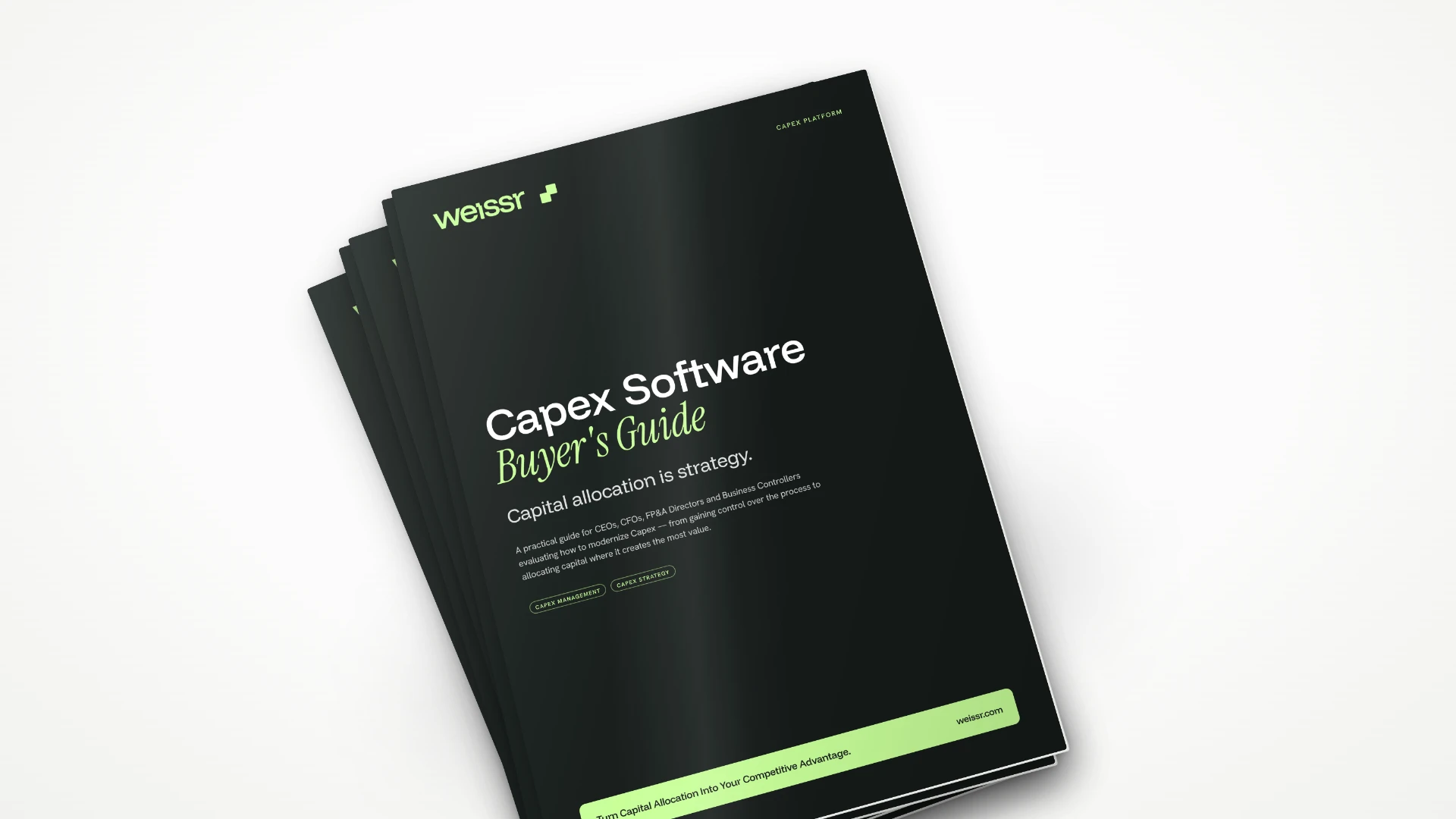
How to tell capex, capital planning and project software apart, and ten criteria to check before you compare vendors.

CEO perspective
Why the companies that outperform on capex will not be those that invest most, but those that allocate best and reallocate fastest.

CEO perspective
Every approved project can have a positive NPV while the portfolio still takes the company somewhere leadership never chose.

Capex fundamentals
Capital expenditure and operating expenditure explained in plain language, with examples, a comparison table and the practical effect on financial governance.

Capex fundamentals
A plain-language introduction to capital expenditure: the categories, the vocabulary, and how capex actually moves through an industrial organisation.

Capex governance
A practical look at the capex approval process, where delays arise and how each stage should work.

Capex forecasting
Why replacing each quarterly forecast makes accuracy difficult to measure, and what companies lose when the history disappears.

Our story
Where Weissr comes from: the founders, the methodology behind the book and how it became a platform for the whole Capex cycle.
Capex Maturity Assessment
Answer a short set of questions on process, data, visibility and cash flow, and get a report showing your level in each area.
Take the assessmentCapex process
The capex process is the end-to-end cycle through which an organisation decides, authorises, delivers and reviews capital investments. It has six connected phases: capital strategy, capex planning, capital budgeting, approval, execution and post-investment review.
Capital strategy sets the direction and the funding envelope. Capex planning turns candidate investments into a prioritised plan. Capital budgeting converts the plan into an approved, funded budget. Approval authorises individual requests. Execution delivers them against the approved baseline. Post-investment review compares outcome with case and feeds the next cycle.
Capex management is the operational half of the capex process: governing approvals, tracking committed and actual cost against the approved budget, forecasting completion, controlling scope changes and confirming benefit realisation at close-out.
Capital expenditure creates or extends an asset and is capitalised on the balance sheet and depreciated over its useful life. Operating expenditure is consumed in the period and expensed immediately. The distinction affects approval authority, reporting and, in most jurisdictions, tax treatment.
Because the phases are handled in different systems by different functions. Strategy lives in slides, planning in spreadsheets, approval in email, execution in a project tool and review nowhere at all. Each handover loses assumptions, so the delivered portfolio drifts from the strategy that justified it.
Standardise the intake so requests are comparable, prioritise on consistent criteria, enforce delegation of authority in the system rather than in a policy document, keep the forecast live against the approved baseline, and run post-investment reviews so estimating improves cycle over cycle.
A capex platform supports the full cycle in one system, connecting strategy, planning, budgeting, approval and execution, and integrating with the ERP so approved amounts, commitments and actual costs stay reconciled without manual re-entry.
See how strategy, planning, budgeting, approval and execution connect in Weissr.
Book a demo