
01
Maintenance capex
Replacements, overhauls and end-of-life renewals that keep existing capacity available. Largely non-discretionary, and usually the largest single block of the budget in asset-heavy industries.
Capex fundamentals
Overview
Everyone in an industrial business uses the word capex. Far fewer agree on where it starts, who owns it and what happens after the money is approved.

The short answer
Capex, short for capital expenditure, is money an organisation spends to acquire, build, upgrade or extend the life of a long-term asset, such as a plant, machine, building or major system. Because the asset delivers value over several years, the cost is capitalised on the balance sheet and depreciated over its useful life rather than expensed at once.
In an industrial group, capex is also the mechanism by which strategy becomes physical. The factories you can operate in five years, the products you can make and the emissions you produce are all consequences of capital decisions taken now. That is why capital allocation is treated as an executive responsibility rather than a budgeting exercise.
Categories
Treating all capital requests as one undifferentiated queue is the most common prioritisation error. These four categories follow different rules and should be reserved in a deliberate order.
01
Replacements, overhauls and end-of-life renewals that keep existing capacity available. Largely non-discretionary, and usually the largest single block of the budget in asset-heavy industries.
02
Investments required by safety, environmental or regulatory obligations. Companies still need to decide when to invest, what the work should cost and how to sequence it across sites.
03
Added capacity, new lines, debottlenecking and market expansion. Decisions depend heavily on return calculations, demand assumptions and sensitivity analysis.
04
Investments that change the shape of the business: new technology, decarbonisation, footprint restructuring. Long payback, high uncertainty, and rarely comparable on NPV alone.
Capex vs opex
The test is whether the spend creates or extends an asset with a useful life beyond the current period. If it does, it is capitalised. If it simply keeps operations running, it is operating expenditure and hits profit immediately.
Consistent treatment matters most in boundary cases. Major overhauls, software implementations, spare-parts strategies and turnaround work all sit close to the line. A written capitalisation policy plus a monetary threshold keeps classification comparable across sites. That consistency is necessary for reliable portfolio reporting. We cover the split in detail in Capex vs Opex.
How it works
Capital does not arrive as a single decision. It passes through a sequence of them, each owned by a different part of the business:
Each step is straightforward on its own. Problems arise when organisations run the steps in different tools and lose context between them. See the capex process for what that costs.
Glossary
Weissr
Weissr is a capex platform for industrial groups. It connects the capital lifecycle in one system: Capex Strategy for long-term direction and the asset base, Capital Budgeting for the envelope, and Capex Management for approvals, execution and close-out, while reporting and dashboards keeping the portfolio position current.
It governs capital decisions rather than replacing your ERP fixed asset register or accounting system; approved capital, commitments and posted actuals stay reconciled between them.
If the question behind your capex is which investments deserve funding at all, see strategic capital allocation, or how Weissr is used by CFOs and finance leaders and FP&A and capital planning teams.
Key takeaways
Follow Weissr on LinkedInfor new Capex Blog posts.

Capex maturity
Signs your Capex process has not kept pace with the business, and a three-minute assessment to see where you stand.
Buyer's guide
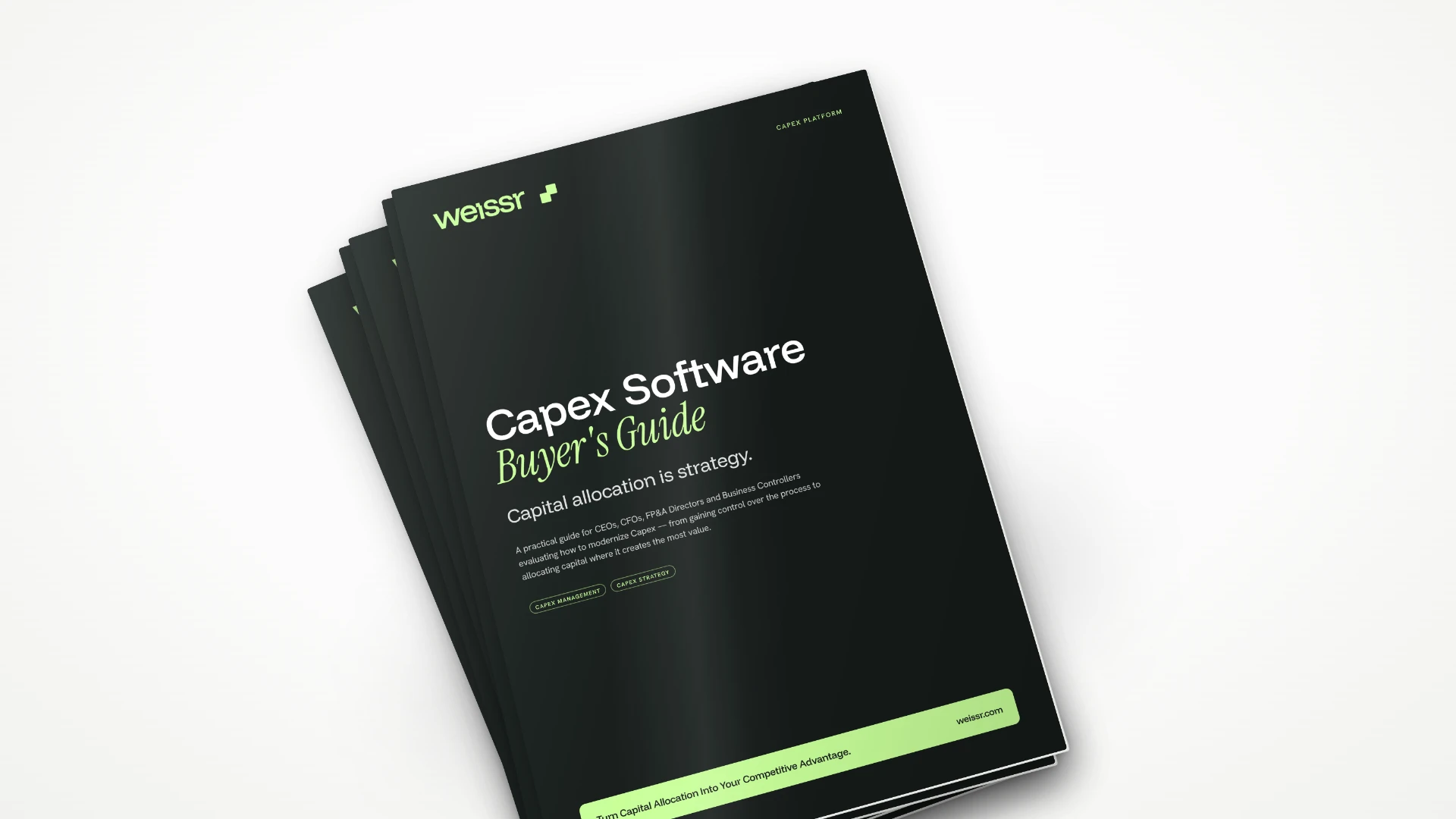
How to tell capex, capital planning and project software apart, and ten criteria to check before you compare vendors.

CEO perspective
Why the companies that outperform on capex will not be those that invest most, but those that allocate best and reallocate fastest.

CEO perspective
Every approved project can have a positive NPV while the portfolio still takes the company somewhere leadership never chose.

Capex fundamentals
Capital expenditure and operating expenditure explained in plain language, with examples, a comparison table and the practical effect on financial governance.

Capex process
How strategy, planning, budgeting, approval, execution and review connect, and why weak handovers undermine capital decisions.

Capex governance
A practical look at the capex approval process, where delays arise and how each stage should work.

Capex forecasting
Why replacing each quarterly forecast makes accuracy difficult to measure, and what companies lose when the history disappears.

Our story
Where Weissr comes from: the founders, the methodology behind the book and how it became a platform for the whole Capex cycle.
Capex Maturity Assessment
Answer a short set of questions on process, data, visibility and cash flow, and get a report showing your level in each area.
Take the assessmentCapex basics
Capex, short for capital expenditure, is money an organisation spends to acquire, build, upgrade or extend the life of a long-term asset such as a plant, machine, building or major system. Because the asset delivers value over several years, the cost is capitalised on the balance sheet and depreciated over its useful life.
Most industrial groups classify capital investment into four categories: maintenance capex to keep existing assets running, compliance capex required by safety or environmental regulation, growth capex to add capacity or enter new markets, and strategic capex that changes the shape of the business. The categories matter because they compete for the same envelope under different rules.
Capex for a period is commonly derived as the change in net property, plant and equipment plus depreciation and amortisation for that period, or read directly from purchases of property, plant and equipment in the investing section of the cash flow statement.
Maintenance capex is capital spend required to keep existing assets operating at their current capability. It includes replacements, major overhauls and end-of-life renewals. It is largely non-discretionary, and in asset-heavy industries it typically consumes the majority of the capital budget before any growth investment is considered.
Ownership is shared. Sites and business units originate requests, finance validates the case and the budget, the CFO and executive team allocate the envelope, delegated approvers authorise individual investments, and project owners deliver them. Capex governance exists to keep those handovers connected.
A capex plan is the prioritised, multi-year set of capital investments an organisation intends to make, with cost profiles, timing and the strategic objective each investment serves. It sits between long-term capital strategy and the annual approved capital budget.
Approved capital is tracked as committed cost, actual spend and forecast at completion against the approved baseline, usually reconciled with the ERP. Deviations are escalated, scope changes are re-approved at the correct authority level, and a post-investment review compares the delivered outcome with the case.
Plan, approve, track and report capital investment without spreadsheets in between.
Book a demo