
PRODUCT VISION
The company will run like a living organism.
Most capex conversations start with the budget cycle. Weissr Capex starts earlier: with where the company needs to be in ten years, and what capital decisions get it there. Tomorrow’s operating systems will be handled end-to-end by AI agents, optimised within constraints set by humans. The framework that defines those constraints stays a human act.
Weissr Capex is the conscious brain.

THE ORGANISM
An autonomous enterprise. A conscious brain.
It is the same split nature already made between the autonomic nervous system and the cortex.
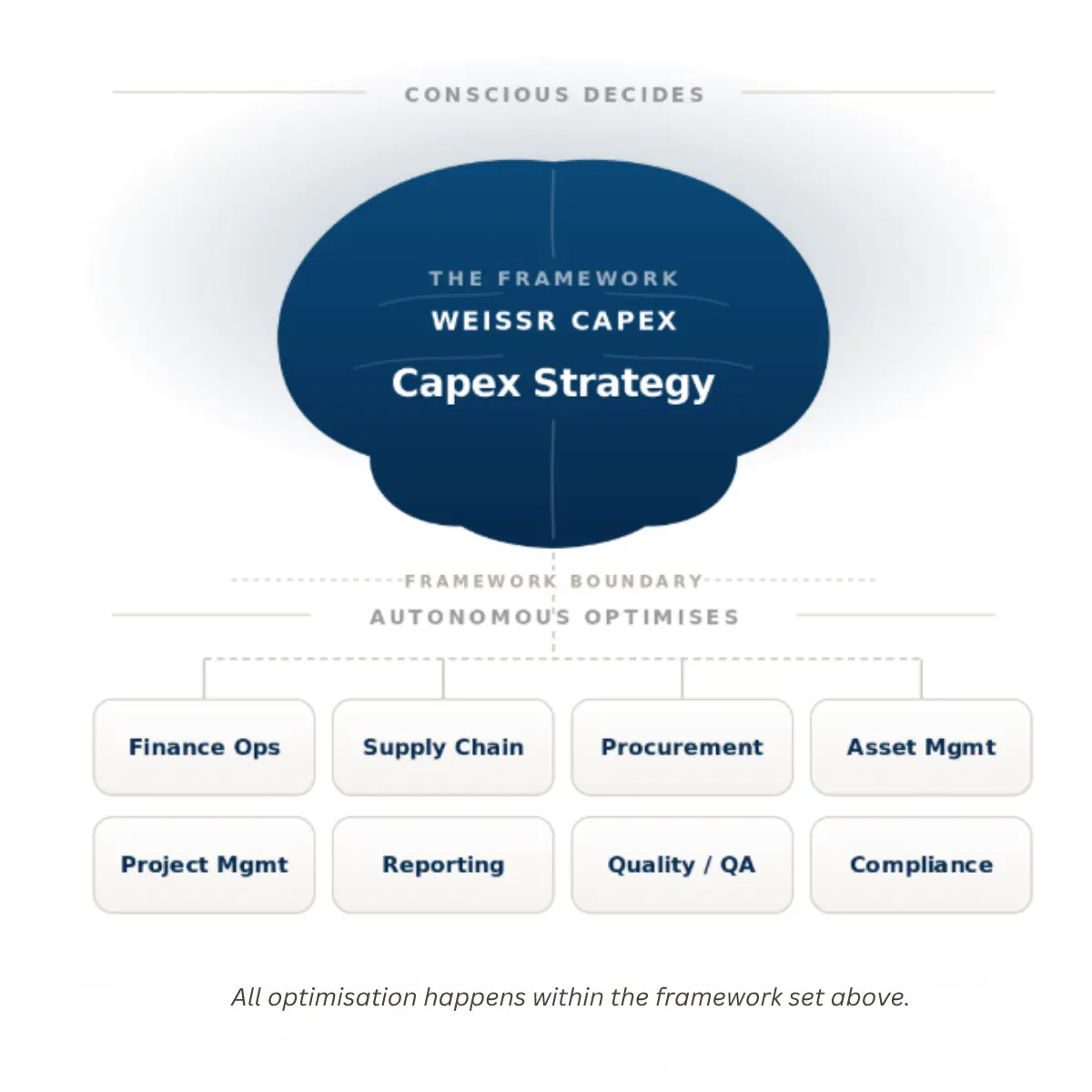
Most systems handled manually today will become autonomous.
Supply chain, finance, procurement: run end-to-end by AI agents, optimising themselves within a given framework.
But the strategic layer cannot be automated.
Where the company goes. Which assets it holds. Where capital is placed. These choices define scope (what the business does) and time horizon (which assets it still owns ten years from now). No algorithm sets this. That is why the strategic layer stays human.
In capital-intensive companies, that framework is the capex strategy.
Weissr Capex Strategy is therefore the conscious brain — and the enabler of every autonomous system below it.
SCALE DOES NOT EQUAL COMMAND
The brain is not the largest organ in the body.
The capex strategy decides the future framework. ERP, supply chain, asset management and procurement are larger than capex by every easy measure, and still downstream of it. They process the present and optimise within that frame. They cannot set the strategy.
“It’s about realising that the capex strategy is the enterprise’s strategy.”
John Williams, CEO, Paper Excellence
THE BODY — DOWNSTREAM
Big, fast, parallel and automatable.
| Capital Budgeting | Allocates the capital the strategy authorised. |
| Capex Management | Executes the projects the budget approved. |
| ERP | Books the transactions the strategy implies. |
| Supply chain | Optimises volumes inside the strategy’s footprint. |
| Asset management | Maintains the assets the strategy decided to own. |
| Procurement | Sources the inputs the strategy committed to. |
This is where most capex software competes: project tracking, budget control, ERP integration. None of it is the brain.
THE BRAIN — UPSTREAM
Big, fast, parallel and automatable.
| Scope | What businesses, segments and assets the company is in. |
| Time | Which assets the company will own a decade out. |
| Capital | Where every euro of capex goes, and where it does not. |
| Future | Holds the company’s future state, encoded as capital choices. |
Where Weissr Capex operates — and where no one else is yet.
DECISION SUPPORT IS NOT THE DECISION
Even the brain can be heavily AI-assisted. Agents generate options, model scenarios, surface risks, run sensitivities. That is decision support, not the decision.
The final decision is different. These are long-cycle, irreversible decisions with strategic consequences that unfold over years. The framework the autonomous body operates within is set by people, deliberately, a few times a year.
THE DECISION STAYS HUMAN
Why humans, not agents
AI can prepare the brain’s work in striking detail. It cannot take its place. Four reasons the framework requires a human signature.
I — IRREVERSIBILITY
You cannot iterate on a 20-year bet
A €500m plant plays out over decades. AI learns by iterating on feedback. Here there is none. Get it wrong and you do not iterate. You live with it. That asymmetry of error is why the decision demands a human signature.
II — INCOMMENSURATE VALUES
There is no objective function
Returns vs decarbonisation. Local jobs vs offshoring. Community impact vs shareholder yield. These are not optimisations. They are choices about which future the company is willing to fund. Choosing among incommensurate values is the working definition of judgement.
III — REFLEXIVITY
The bet changes the world it bets on
Three new mills shift pulp prices. A regional decarbonisation programme moves the regulatory landscape. AI models are trained on historical data: they optimise within a world assumed to stay roughly the same. Capex strategy assumes that world will shift in response to your own bets.
IV — ACCOUNTABILITY
Someone has to sign their name
When €100m+ ends up in a stranded asset, a human answers to the board, the regulator and the capital markets. You cannot hold an agent accountable. The EU AI Act already classes capital-decision AI as high-risk.
HOW IT WORKS
The Decision Hub.
At the centre sits the Asset Base, the system of record for what the company owns, operates and is investing in. It holds not only today’s assets, but the future asset portfolio encoded in the company’s capital decisions. Three connected stages continuously update it.

01 / Direction
Capex Strategy
Defines the direction and required asset evolution. The framework against which everything else is optimised.
02 / Allocation
Capital Budgeting
Allocates the capital and structures the investment programmes. Translates strategy into a portfolio with constraints and dependencies.
03 / Execution
Capex Management
Executes the projects, generating actuals that update the Asset Base and feed back into strategy. The learning loop closes here.
OPERATING MODEL
The agent fleet is the product.
Five agents, each with a clearly scoped role and a defined interface to the Asset Base. Users delegate intent through the Decision Support Agent.
Strategy Agent
Design the future. Generate, challenge and compare strategy options against the Asset Base.
Budget Agent
Allocate capital. Build and continuously update the capital budget under the active strategy.
Capex Management Agent
Approve, execute and track projects through the full lifecycle. Updates actuals back to the Asset Base.
Decision Support Agent
The conversational surface for the human user. The entry point to the hub. Delivers answers, recommendations and approvals.
Integration Agent
Import and export data across the surrounding system landscape via MCP secure connectors.
What the user can ask In development
Challenge and present the ten best strategies.
Update and present the capital budget accordingly.
Prepare and suggest urgent capex project approvals.
Present projects where actions are needed.
INTEGRATION
Connects to what you already have, via MCP.
The Decision Hub does not replace the customer’s landscape. It connects to it through MCP (Model Context Protocol) secure connectors — the open standard for connecting AI agents to external systems. Data flows in both directions. Customer-side or third-party agents can operate against the same surface.
Enterprise systems
Master data, governance, productivity
| ERP | Project data and master data: profit centres, GL, FX rates. |
| Identity Management | Users, roles, permissions. |
| BI Tools | Visualisations of data drawn from connected systems. |
| Project Management | Project status, time plans, dependencies, resource allocation. |
| Office 365 | Teams, Excel, Word, Outlook, SharePoint. |
Engineering & operational systems
The physical asset perimeter
| Supply Chain Optimisation | Optimal volumes of optimal products at optimal locations. |
| CAD Systems | Equipment, components, visualisations. |
| Asset Management | Asset information, location, maintenance schedules, depreciation, disposal. |
| Procurement | Supplier sourcing, purchase orders, committed spend. |
A second MCP connector exposes the hub to the user.
The user reaches the Decision Hub through a conversational AI Agent Interface. Not a UI in the classical sense, but a surface where intent is delegated and answers, recommendations and approvals come back.
WHAT THIS MEANS
When strategy governs capital, five things change.
Five things that change for your company.
01
Capex Strategy as anchor
The product becomes the place where the strategic framework is set and continuously updated. Not a passive book of investments.
02
MCP-first architecture
Every workflow action and data object is exposed as an MCP tool, so customer-side and third-party agents can operate against the hub natively.
03
Agent-first interface
The agent fleet is the product surface. The UI shrinks to a thin admin and visualisation layer for governance and exception handling.
04
Asset Base as system of record
Strategy, budget and execution all converge on the same shared model, closing the learning loop between plan and outcome.
05
Integrate, don’t re-platform
The hub plugs into ERP, project management, BI, Office, supply chain, CAD, asset management and procurement through MCP — rather than asking customers to migrate.
Talk to us
No commitment. 30 minutes.