
Draft: Capital budgeting

Capital budgeting software for precise and effective capital allocation
Turn capital strategy into approved, governed budgets.
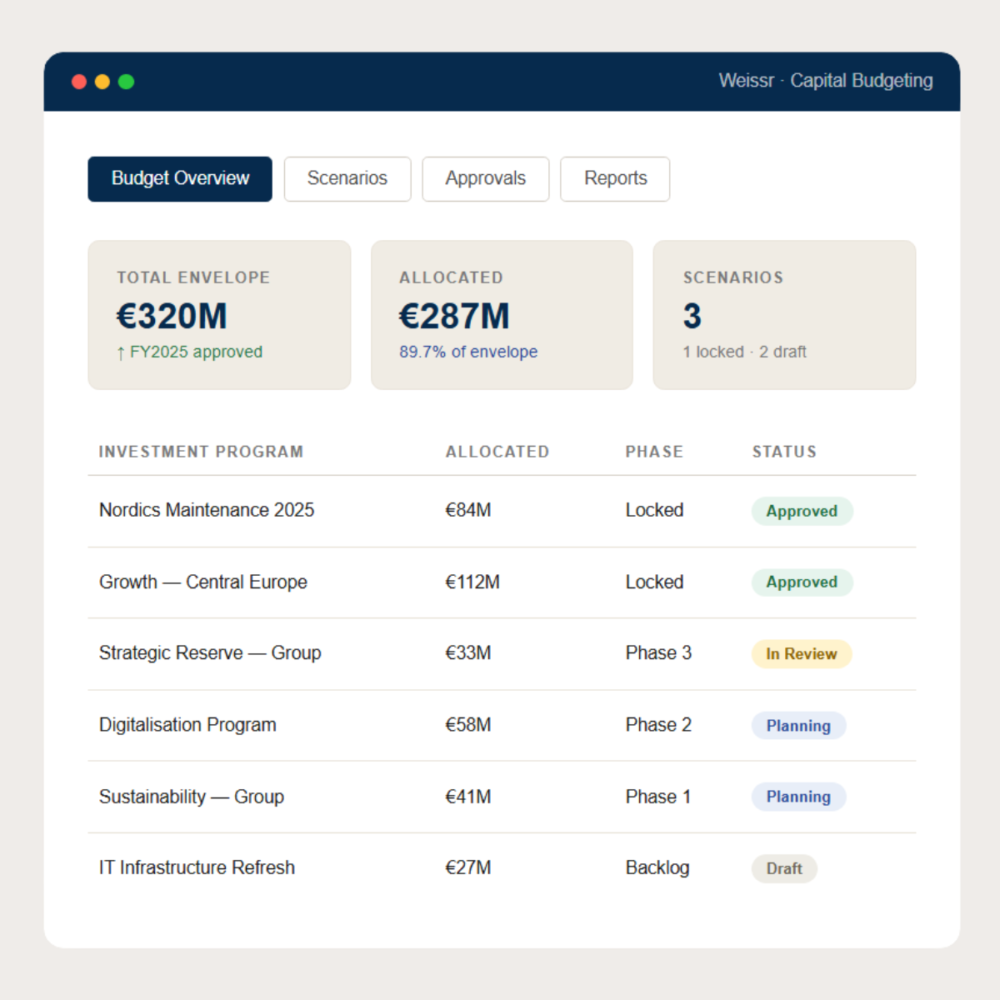
Plan, evaluate, and approve investments in one platform. Capital Budgeting is the decision layer between Capex Strategy and Capex Management. It reconciles top-down strategy with bottom-up demand, links every investment to a specific asset, and gives finance a complete audit trail and real-time visibility.
1
Approved scenario frozen as an immutable snapshot. No version drift. No parallel files.
100%
Audit trail on every allocation decision, at every organisational level.
Group → BU
Capital Allocation Pools at every level of your organisation.
Built for organisations managing $10M+ annual capex across multiple sites, divisions, and currencies.
WHY IT MATTERS
Why finance leaders choose Weissr Capital Budgeting
Capital is scarce, capex decisions are political, and the audit trail is rarely complete. Weissr Capital Budgeting solves all three. It turns your long-term investment strategy into approved, funded, and auditable budgets — then hands those budgets to execution without losing the thread.
One source of truth
All capex data lives in one platform with automatic updates from your ERP and EAM systems. Every investment is linked to a specific asset — so execution data stays connected to the asset record and feeds back into strategy. No parallel spreadsheets. No version drift.
Top-down meets bottom-up
Strategic envelopes are set by organisational level and asset category. Bottom-up demand is reconciled inside explicit scenarios. Trade-offs are visible, not buried in side conversations.
Scenario-based decisions
Build multiple alternative futures per cycle. Compare on DCF, payback, and strategic fit. Approve one scenario and freeze it as an immutable snapshot.
Multi-year governance
A single approval covers the full lifetime of a multi-year investment — phased across cycles, confirmed annually, re-approved only when scope or lifetime envelope materially changes. No re-opening business cases every year.
Governed reallocation
Capital moves through pools — never directly between projects. Every transfer follows the organisational hierarchy, requires approval, and creates a permanent audit event.
Targets and budgets — separately tracked
Top-down steering targets and approved pool allocations are two distinct data series. Set a €50M target in Phase 1. Land at €45M after reconciliation. Track variance against both throughout the cycle.
“A ONE-stop flow, where you have everything, and everything flows seamlessly through. You don’t need to think twice — once you’re in it, the flow stays intact.”
— CFO, Chemical industry
THE PROBLEM
Most capital budget cycles are built on assumptions that are outdated before approval.
In most capital-intensive organisations, the annual budget cycle is the most consequential finance process. And the most fragmented. Strategy is defined in one place, requests live in another, scenarios are built in Excel. By the time a budget is approved, half the assumptions have changed.
The budget is outdated before it is approved.
The cycle takes months. Requests change. Priorities shift. The Excel model from month one is still the basis for final decisions. Finance presents numbers that leadership cannot fully trust. And everyone knows it.
Scenarios live in spreadsheets, not in a system.
Each budget alternative is a separate file, owned by a different person. Comparing scenarios means reconciling versions manually.
No one can trace why a budget decision was made.
Six months after approval, when a project is overspending, the question is always the same: what was the basis for this decision? The answer is usually an email thread that no longer exists.
Reallocation happens outside the system.
When priorities change mid-cycle, capital moves informally. A conversation. An email. A manual adjustment. There is no pool structure, no approval chain, no audit trail. Just a number that no longer matches what was approved.
HOW IT WORKS
How it works
Weissr Capital Budgeting is the decision layer between Capex Strategy and Capex Management. It takes long-term investment direction from strategy, reconciles it with operational demand, and hands governed, auditable budgets to execution.
COMPLETE CAPITAL BUDGETING CAPABILITIES
Complete capital budgeting capabilities.
Built for complex, multi-site organisations managing annual, rolling, and multi-year budget processes with full governance and full traceability.
PART OF A CLOSED LOOP
Capital budgeting that makes every next investment decision smarter.
Weissr Capex is three integrated modules sharing one asset base. Capital Budgeting is the decision layer where long-term strategy becomes funded, governed commitments — and where execution results feed back to make the next cycle sharper.
- ·Long-term investment needs and capital trajectories
- ·Strategic directives and site-level direction
- ·Asset-category priorities and organisational envelopes
- ·Approved budgets with authorised spend levels per project
- ·Approved scenarios with conditions and phasing
- ·Full approval history on every Capex Request
- ·Actual costs vs. approved budgets
- ·Asset updates and bottom-up demand signals
- ·Close-out data for post-investment review
WHAT CHANGES
What changes when capital budgeting is fully integrated
Budgeting forms the basis for effective capital planning. With Weissr Capex, budgeting is built directly into the capex process. Teams work from the same financial structure throughout planning, approval, and execution.
Connected planning and approvals.
Weissr connects forecasts, budget proposals, approvals, and portfolio overviews through a single shared data source. When teams adjust figures, the changes appear instantly across all stages. Rework is reduced. Review cycles are shorter. Decision-makers see the financial impact before approvals take place.
Budgeting linked to governance and delivery.
Every approved budget becomes the baseline for execution. Project teams work against the same numbers that were approved. Actuals flow in automatically from your ERP and EAM. Any deviation is visible the moment it happens — not at the end of the quarter when it is too late to act.
WHY IT WORKS IN PRACTICE
Built to fit your organisation, not the other way around.
Rapid time-to-value.
Enterprise implementation typically takes between 1 and 4 months. Our onboarding team configures workflows, forms, and integrations around your existing process. You do not need to rebuild how your team works.
Deeply configurable.
Approval workflows, investment request forms, budget structures, and financial criteria are all configurable to match how your organisation already works. Weissr adapts to your process. Not the other way around.
Built for scale.
Designed for organisations managing capex across multiple sites, divisions, and currencies. Whether you manage capital across 5 sites or 50, Weissr handles the hierarchical control, multi-currency requirements, and data volumes that enterprise capex demands.
BUILT FOR
For the teams that run the budget cycle. And the financial leaders who own the outcome.
Weissr Capital Budgeting serves the finance practitioners who run the budget cycle daily and the executives who make capital allocation decisions from it.
GROUP FINANCIAL CONTROLLER · FP&A MANAGER · CAPEX PORTFOLIO MANAGER · INVESTMENT CONTROLLER · FINANCE DIRECTOR
The Capex Champion is the person who holds the budget cycle together. Collecting requests from across the group, building scenarios, managing the approval process, and presenting numbers to leadership. The challenge is that the data is only as good as the files that could be found. Every cycle starts with the same problem. Too many sources. Too little time. No system that does what is actually needed.
WHAT WEISSR CAPITAL BUDGETING GIVES YOU
- ✓One place where every request, every scenario, and every approval lives. Always current. Never a parallel file.
- ✓Scenarios built and compared inside the system. Approve one. Freeze it as an immutable snapshot.
- ✓Full approval history and decision rationale permanently recorded. Retrievable in seconds.
- ✓Capital Allocation Pools that enforce budget boundaries automatically.
- ✓Budget targets tracked alongside approved allocations — the original Phase 1 target never disappears when the final number lands lower.
- ✓New markets onboarded into the same budget structure in days. Same process, same forms, same governance from day one.
CFO · GROUP CFO · VP OF FINANCE · CEO (IN TRANSFORMATION CONTEXTS)
Capital allocation is one of the most consequential decisions an organisation makes. But the process that produces those decisions is built on assumptions, compromises, and manual reconciliation that nobody fully trusts. When the board asks why a project is overspending, the answer needs to be traceable, defensible, and immediate.
WHAT WEISSR CAPITAL BUDGETING GIVES YOU
- ✓Strategy-to-budget traceability. Every funded project linked to a strategic directive, visible before you approve.
- ✓Scenario comparison on DCF, payback, and strategic fit. See the trade-offs, not just the recommendation.
- ✓Immutable approval records. Every decision documented, every condition recorded, nothing changed retroactively.
- ✓Budget targets and approved allocations tracked as separate data series throughout the cycle.
- ✓Real-time budget vs. forecast vs. actuals. Always current. No two-day preparation before a board meeting.
- ✓Governed reallocation. Capital moves through an approved process with a full audit trail.
FAQ
Frequently asked questions
Bring precision and control to your capital budgeting process.
See Weissr Capital Budgeting in practice. 30-minute demo. No commitment.